Large-Scale 3D Logo Installation
(AT College of Education)
High-Precision Dimensional Branding
with Lightweight Structural System
A large-format 3D logo installation engineered for outdoor display, combining sharp dimensional accuracy with durable coating and lightweight construction for simplified transport, handling, and installation.
| Parameter | Value |
|---|---|
| Location | University campus environment (US) |
| Industry | Education / Institutional Branding |
| Client Type | College / Campus Facilities |
| Product | Large-Scale 3D Logo Structure |
| Materials | EPS Foam + Polyurea Coating + Paint System |
| Timeline | ~2–3 weeks |
| Budget Range | $ |
Project overview
This project involved the fabrication of a large-scale three-dimensional logo for a college campus environment, designed to function as a prominent outdoor branding element.
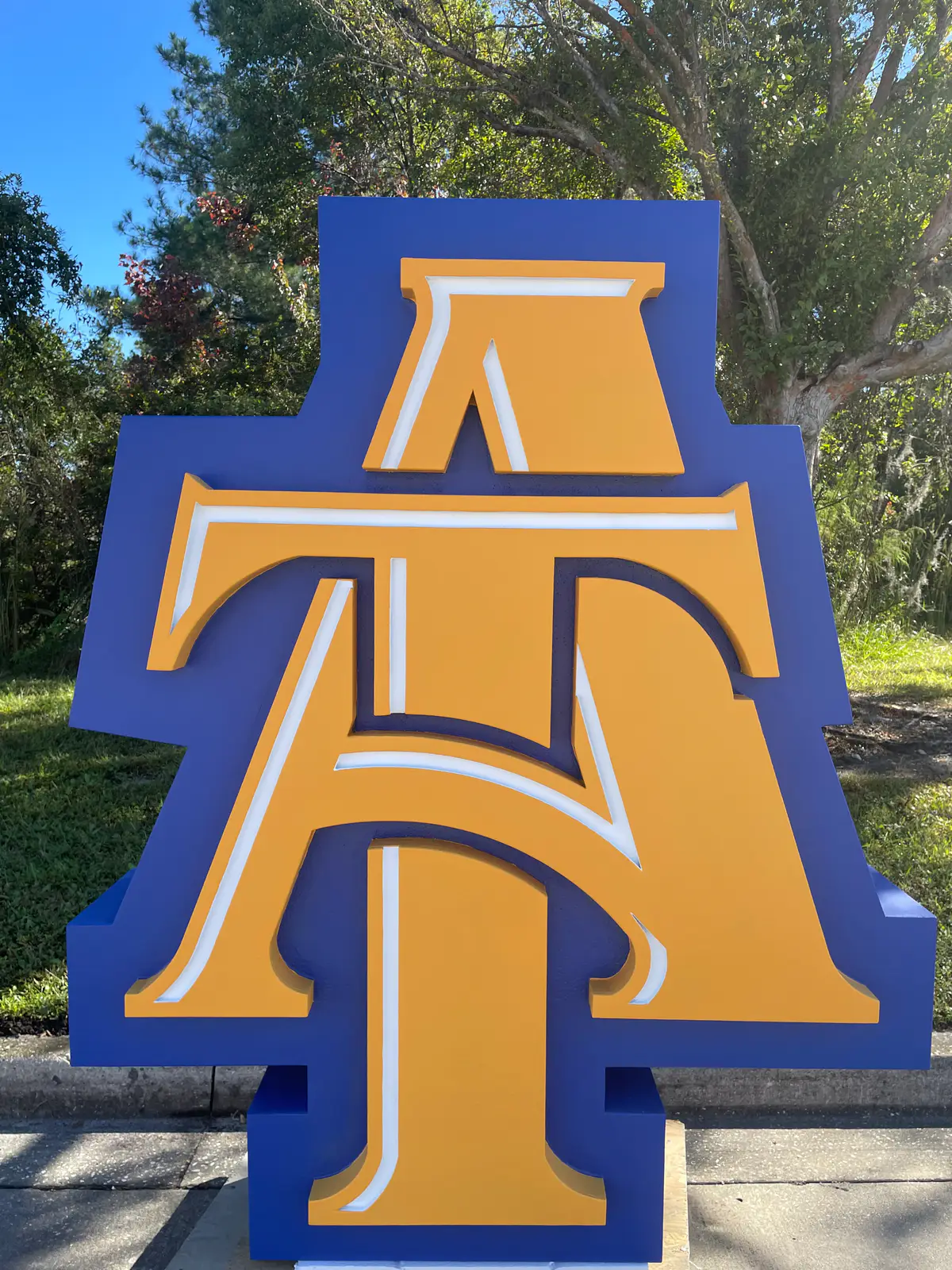
The structure needed to reproduce the institution’s visual identity with clean dimensional layering, sharp edge control, and accurate color separation while remaining practical to move, place, and install.
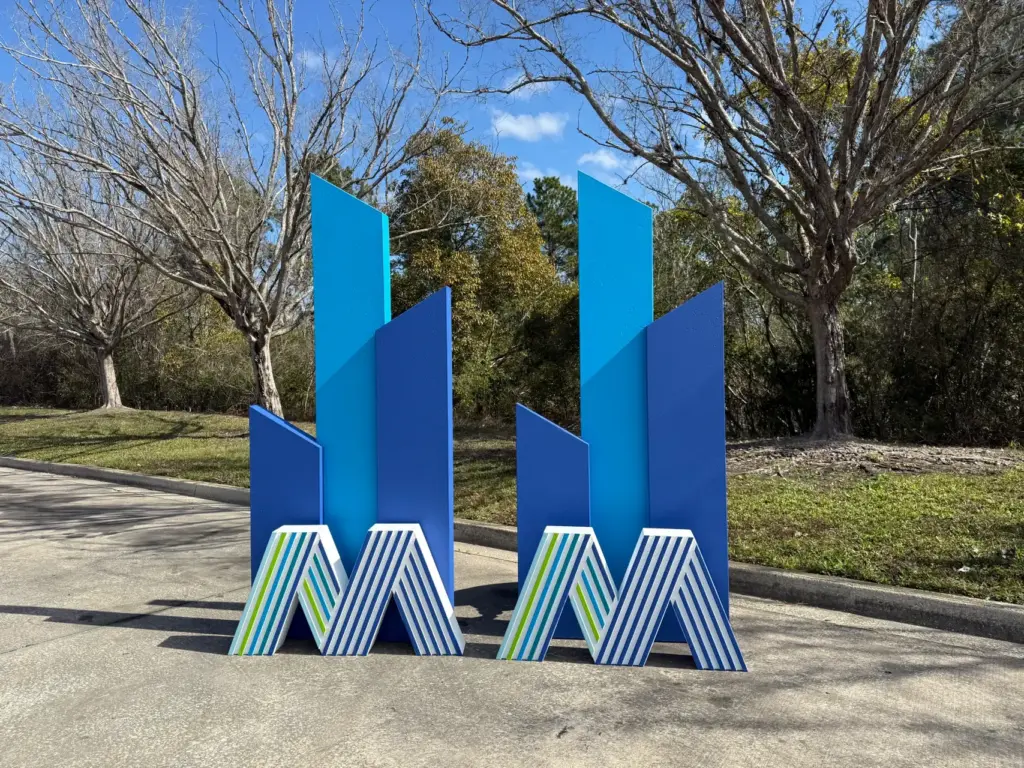
The final result delivers a bold, high-visibility branded feature with strong surface quality, controlled proportions, and a durable exterior-ready finish.
The Challenge
- Outdoor installation requiring strong brand visibility and clean presentation from multiple viewing angles.
- Large scale increased the risk of distortion in logo proportions and negative space relationships.
- Flat color fields and crisp white accents meant any imperfection in surface prep or edge finishing would be immediately visible.
- Traditional solid-material construction would have added unnecessary mass, transport difficulty, and installation complexity.
- The piece needed enough structural stability for outdoor placement without relying on bulky external framing.
THE SOLUTION (ENGINEERING APPROACH)
Material System
- EPS foam core used as the primary structural body to create volume without excessive weight.
- Polyurea coating applied to improve surface strength, impact resistance, and weather durability.
- Multi-layer paint system used for crisp blue, gold, and white color separation.
- Smooth finish strategy selected to support clean institutional branding rather than scenic texturing.
Structural System
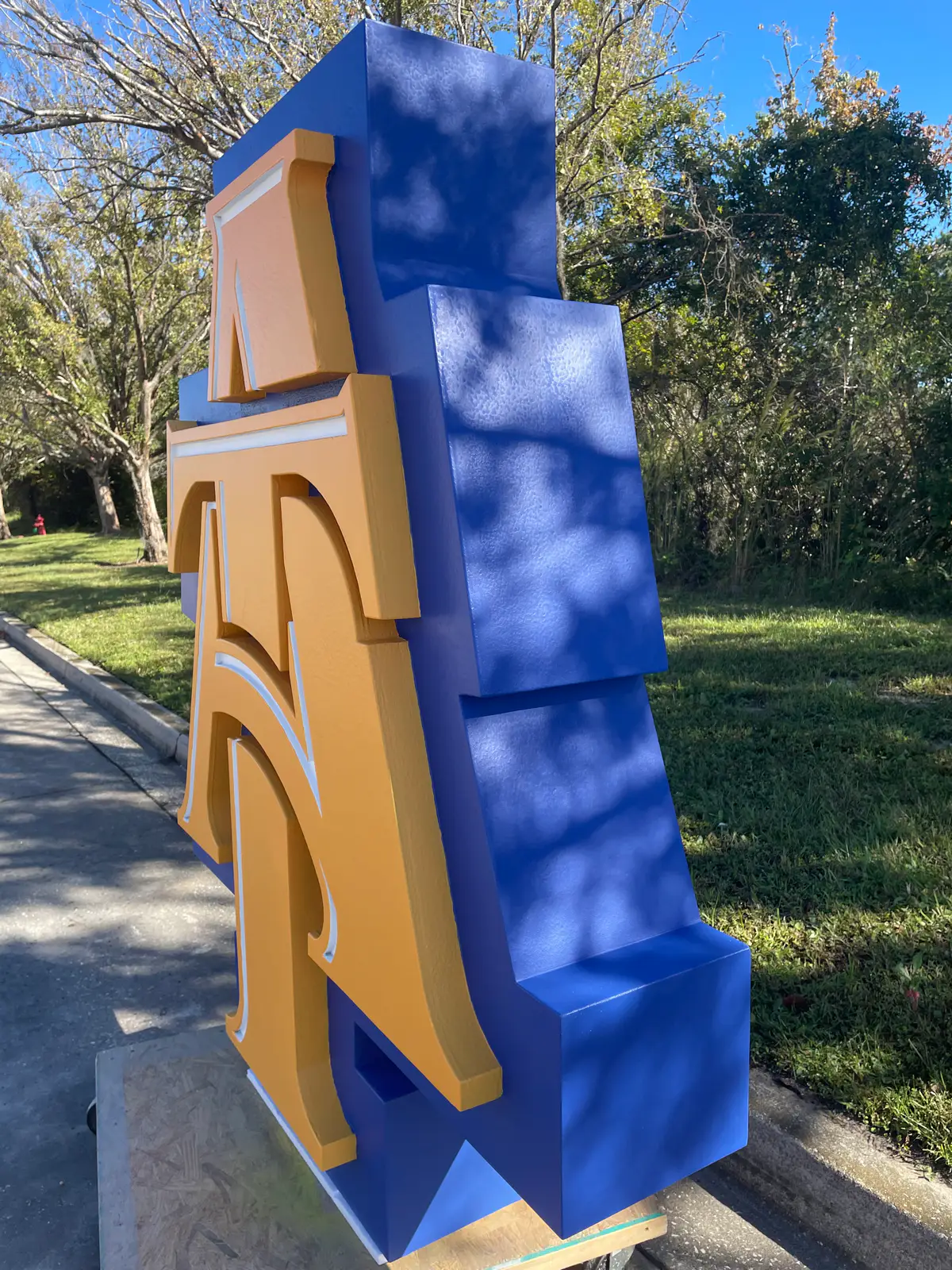
- Reinforced internal structure used to stabilize the tall, freestanding mass.
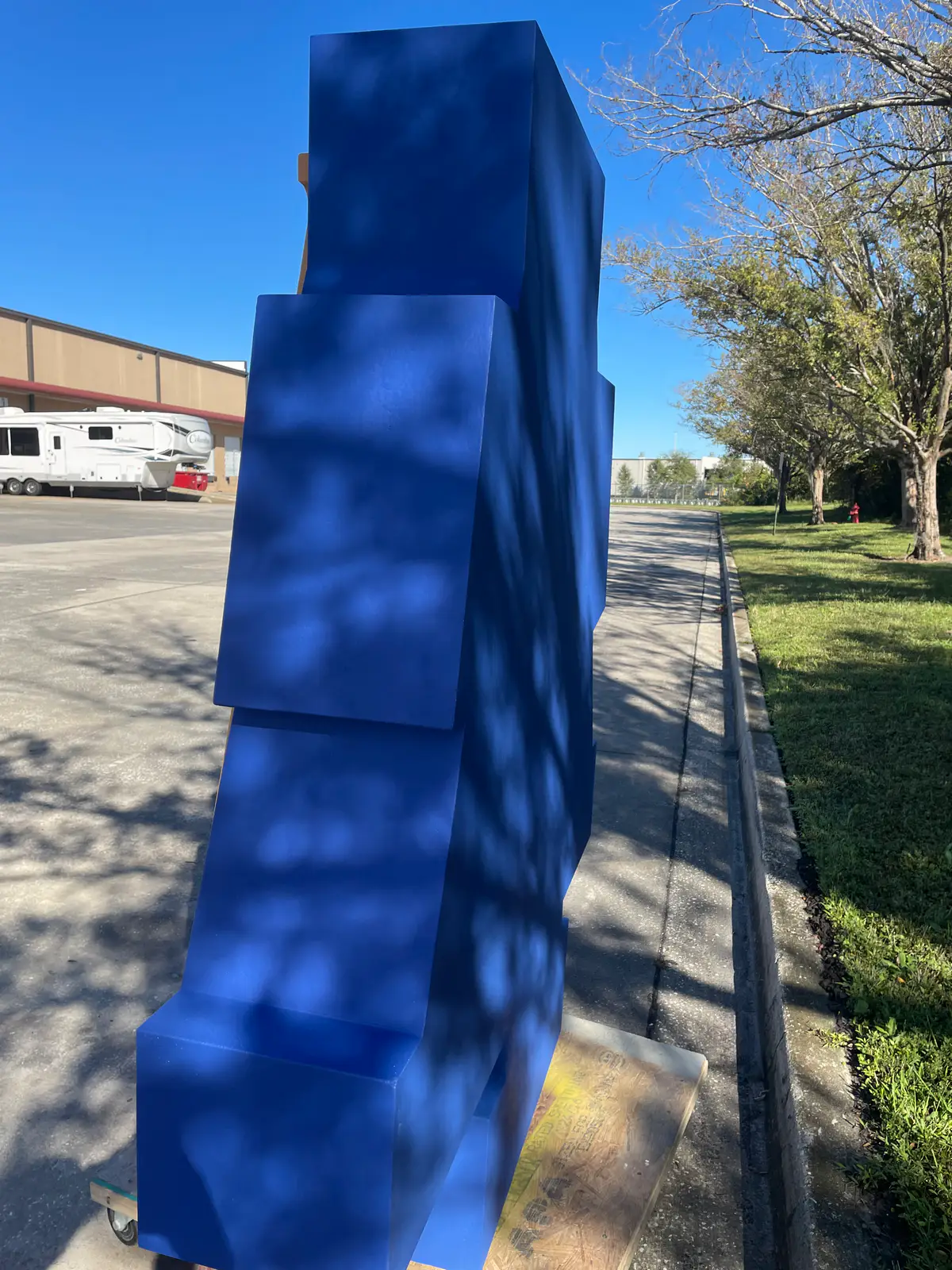
- Deep base geometry helped distribute load and improve balance.
- Integrated support mass reduced the need for visible external bracing.
- Overall structure designed to remain lightweight while preserving dimensional depth.
Fabrication
- CNC precision cutting used for exact logo geometry and repeatable contour control.
- Layered construction allowed the dimensional build-up of the mark without losing proportion.
- Hand finishing refined edge transitions, flat fields, and surface consistency.
- Controlled paint process ensured clean transitions between colors and accent lines.
SYSTEM ARCHITECTURE
- EPS structural core for mass and shape control.
- Internal reinforcement for stability and handling integrity.
- Polyurea coating for durability and surface hardening.
- Surface finishing layer for smoothing and detail refinement.
- Paint system for color accuracy, protection, and brand consistency.
Result: High-precision branded structure with reduced weight, strong surface quality, and simplified installation logistics.
BEFORE / AFTER (ADAPTED)
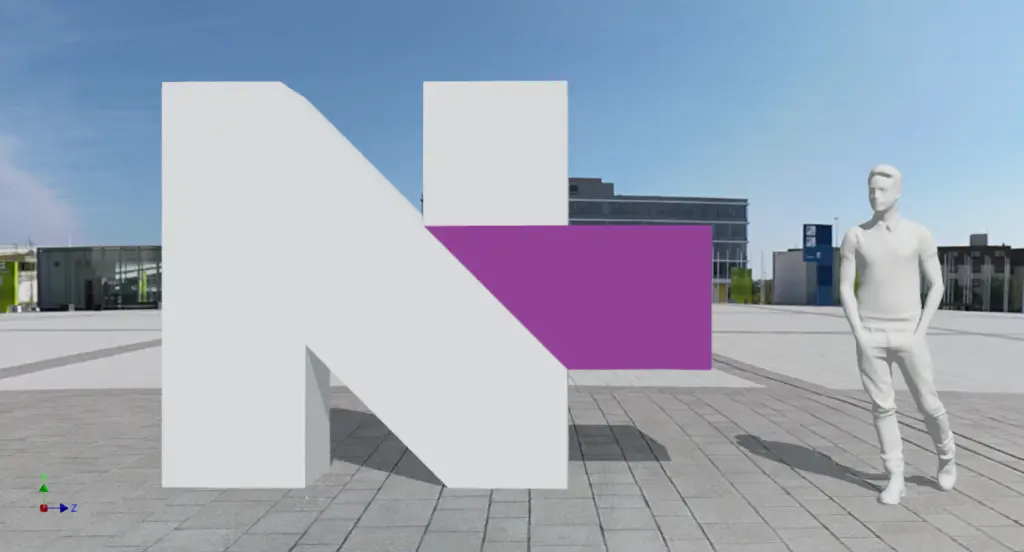
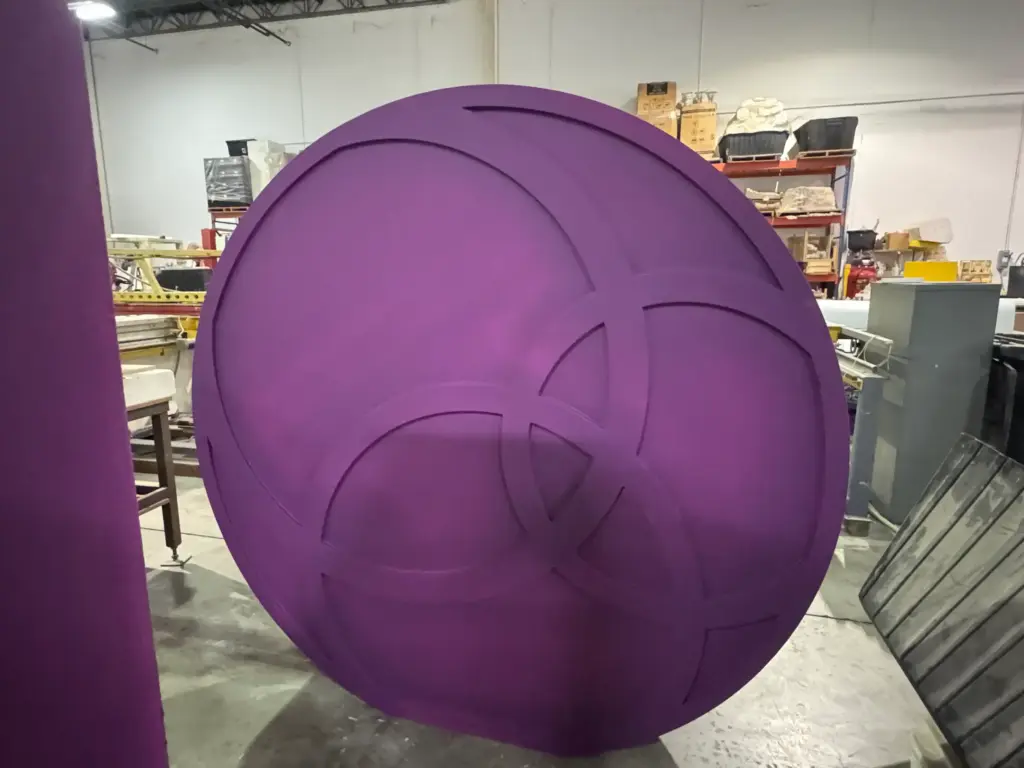
Pre-installation: raw structural form established after CNC shaping and assembly, with geometry, depth, and mass balanced before coating and final paint.
Final result: fully finished logo with sharp edges, accurate color blocking, clean white accent detailing, and strong visibility as a freestanding campus branding element.
IMPLEMENTATION PROCESS
Step 1 — Design (2–3 days)
Logo scaling, proportion validation, and dimensional layout planning.
Step 2 — Engineering (2 days)
Reinforcement planning, balance strategy, and outdoor performance considerations.
Step 3 — Fabrication (5–7 days)
CNC cutting, layered assembly, shaping, and surface refinement.
Step 4 — Finishing (2–3 days)
Polyurea coating, smoothing, masking, and precision painting.
Step 5 — Delivery & Installation (1–2 days)
Lightweight transport and straightforward on-site placement without heavy lifting equipment.
RESULTS (KEY METRICS)
- Up to 80–90% lighter than comparable solid-material constructions.
- Installation completed 2–3x faster than a heavier traditional build approach.
- Eliminated the need for cranes or major heavy lifting equipment.
- Maintained high dimensional accuracy at large scale.
- Delivered a durable outdoor finish designed for environmental exposure.
- Created a strong, instantly recognizable institutional branding feature with clean visual impact.
VALUE ANALYSIS (TCO)
| Parameter | Traditional Build | Foam-Based System |
|---|---|---|
| Weight | Heavy | Lightweight |
| Installation | Complex | Fast |
| Transport | Expensive | Efficient |
Precision | Moderate | High |
| Surface Finish | Variable | Controlled |
| Maintenance | Moderate | Low |
COMPLIANCE & ENGINEERING
- Designed for stable outdoor placement.
- Weather-resistant coating system supports exterior use.
- Lightweight structure reduces installation risk and simplifies handling.
- Durable finish helps maintain visual quality over time.
CLIENT FEEDBACK
“The final piece delivered exactly the visual impact we were looking for, with clean lines and strong presence. Installation was straightforward, and the structure performed well in an outdoor environment.”

FAQ
Can complex curved brand elements be accurately reproduced in 3D?
Yes — CNC fabrication combined with layered construction allows precise replication of complex geometries.
How is structural stability achieved in suspended designs?
Internal reinforcement and distributed support points ensure stability while maintaining a lightweight structure.
Is the structure suitable for repeated installations?
Yes — sectional fabrication allows for transport, reuse, and reinstallation.
How does the finish perform under lighting conditions?
Smooth coated surfaces are optimized for lighting, ensuring clean reflections and consistent color appearance.
Can the installation be adapted to different booth sizes?
Yes — the system is fully scalable and can be adjusted to various spatial configurations.